Showing posts with label Politics. Show all posts

5.15.2007

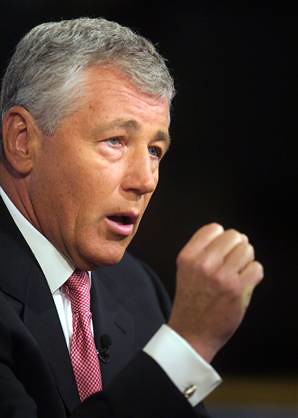
Hagel / Bloomber Ticket?


Two Republicans running together doesn't exactly sound like a 'third party ticket' to me, but...

Via CNN:

WASHINGTON (CNN) -- Expressing dismay over the Republican Party's trajectory, Sen. Chuck Hagel said Sunday that an independent presidential bid would be good for the nation.

And Hagel, R-Nebraska, did not rule out the possibility that he might be the one to do it, perhaps in alliance with New York City Mayor Mike Bloomberg.

"I am not happy with the Republican Party today," the self-described lifelong Republican from Nebraska told CBS' "Face the Nation." "It's been hijacked by a group of single-minded, almost isolationist insulationists, power-projectors," he said.

Hagel said he would decide by late summer whether to run for president.

"I think a credible third party would be good for the system," he said.
In reality, a Hagel / Bloomberg ticket would be less a 'third party run' and more a sign of the final schism between the two wings of the Republican Party.

While I applaud Hagel for his courage to speak out about the direction of the Republican Party, but his critique is a bit off. "It's been hijacked by a group of single-minded, almost isolationist insulationists, power-projectors."

Power-projectors are unlikely to be isolationists. Isolationists are unlikely to get American bogged down in intractable wars of choice. Insulationists are unlikely to be Republicans for the simple fact that keeping American wages high will cut into profits.

I think that if Hagel had said that the Republican Party had been hijacked by fiscally irresponsible religious interventionists, he'd have been more accurate. And incidentally, a platform of disentangling American from Iraq, fiscal responsibility, and movement away from legislating religion would probably be a pretty fertile platform for a third party - except that the Democratic Party has that pretty well staked out.

Sorry Chuck.

5.10.2007

This Really Bothers Me

The headline from Shailagh Murray and Jonathan Weisman's Washington Post story today:

Bush Told War Is Harming The GOP
Before we delve into the contents of the article, let's examine what's going on here. A bunch of GOP Representatives went to the White House and told the President that he might want to rethink the way he's handing Iraq because the way he's handling it right now may lead to political losses in the 2008 election.

Bush needs to change the way that he's handling Iraq BECAUSE IT'S DAMAGING THE FUCKING COUNTRY!

Apparently the fact that there are American men and women fighting and dying in Iraq to referee a civil war isn't a good reason to change course. Devastating and lasting damage to the readiness of our military isn't a good reason to change course. The damage to America's standing in the world isn't a good enough reason. The fact that the Iraqis want us gone isn't a good enough reason.

But Republicans loosing elections just might work.

The contents of the Washington Post story:
House Republican moderates, in a remarkably blunt White House meeting, warned President Bush this week that his pursuit of the war in Iraq is risking the future of the Republican Party and that he cannot count on GOP support for many more months.

The meeting, which ran for an hour and a half Tuesday afternoon, was disclosed by participants yesterday as the House prepared to vote this evening on a spending bill that could cut funding for the Iraq war as early as July. GOP moderates told Bush they would stay united against the latest effort by House Democrats to end U.S. involvement in the war. Even Senate Democrats called the House measure unrealistic.

But the meeting between 11 House Republicans, Bush, Secretary of State Condoleezza Rice, Defense Secretary Robert M. Gates, White House political adviser Karl Rove and presidential press secretary Tony Snow was perhaps the clearest sign yet that patience in the party is running out. The meeting, organized by Rep. Charlie Dent (Pa.), one of the co-chairs of the moderate "Tuesday Group," included Reps. Thomas M. Davis III (Va.), Michael N. Castle (Del.), Todd R. Platts (Pa.), Jim Ramstad (Minn.) and Jo Ann Emerson (Mo.).

"It was a very remarkable, candid conversation," Davis said. "People are always saying President Bush is in a bubble. Well, this was our chance, and we took it."
You cannot imagine how much this disgusts me. It is one more example of this Administration putting party before country.

THAT'S being un-American.

1.09.2007

More Thoughts on Religion

Once more, a late start. Damn job getting in the way of blogging! But to the point...

On Faith
in the Washington Post has a fascinating piece up on the religios affilliations of the new Congress:

The new 110th Congress will, for the first time, include a Muslim, two Buddhists, more Jews than Episcopalians, and the highest-ranking Mormon in congressional history, the Religion News Service's Jonathan Tilove reports. Roman Catholics remain the largest single faith group in Congress, accounting for 29 percent of all members of the House and Senate, followed by Baptists, Methodists, Presbyterians, Jews and Episcopalians.

Following are tables showing the religious affiliation of Congress as a whole, as well as the denominations of individual senators and representatives:

Religion.......................House...Senate....% Congress...% Population
AME (v) ............................... 2 ......... 0 ....... 2 ..... 0.4 ......... (u)
Anglican ............................. 1 ......... 0........ 1 ..... 0.2 .......... (w)
Assembly of God ...............4 ......... 0........ 4 ..... 0.7 ......... 0.5
Baptist ................................60 ......... 7...... 67 ... 12.5 ....... 16.3
Buddhist ............................ 2 ......... 0........ 2 ..... 0.4 ........ 0.5
Christian (x) ......................16 ......... 2...... 18 ..... 3.4 ......... 6.8
Christian Reformed ......... 2 ......... 0........ 2 ..... 0.4 .......... (y)
Christian Scientist ........... 5 ......... 0........ 5 ..... 0.9 ......... 0.1
Church of Christ ............... 1 ......... 1........ 2 ..... 0.4 ......... 1.2
Church of God .................. 0 ......... 1........ 1 ..... 0.2 ......... 0.5
Congregationalist ............ 0 ......... 1........ 1 ..... 0.2 .......... (z)
Congregation.-Baptist .... 1 ......... 0........ 1 ..... 0.2 .......... (u)
Disciples of Christ ........... 2 ......... 0........ 2 ..... 0.4 ......... 0.2
Eastern Orthodox ............. 4 .......... 1........ 5 ..... 0.9 ......... 0.3
Episcopalian ................... 27 ....... 10....... 37 ..... 6.9 ......... 1.7
Evangelical ........................ 2 ......... 0......... 2 ..... 0.4 ......... 0.5
Evangelical Lutheran ....... 1 ......... 0........ 1 ..... 0.2 .......... (u)
Evangelical Methodist ..... 1 ......... 0......... 1 ..... 0.2 .......... (u)
Hindu .................................. 0 ......... 0........ 0 ..... 0.0 ......... 0.4
Jewish .............................. 30 ....... 13...... 43 ..... 8.0 ......... 1.3
LDS (Mormon) ............... 10 ......... 5...... 15 ..... 2.8 ......... 1.3
Reorganized LDS ........... 1 ......... 0........ 1 ..... 0.2 .......... (u)
Lutheran ......................... 14 .......... 3...... 17 ..... 3.2 ......... 4.6
Methodist ....................... 48 ........ 13...... 61 ... 11.4 ......... 6.8
Muslim ............................. 1 .......... 0........ 1 ..... 0.2 ......... 0.5
(Church of) Nazarene .... 1 .......... 0........ 1 ..... 0.2 ......... 0.3
Presbyterian ................... 35 .......... 9...... 44 ..... 8.2 ......... 2.7
Protestant (x) .................. 22 .......... 4...... 26 ..... 4.9 ......... 2.2
Quaker ............................... 1 ......... 0........ 1 ..... 0.2 ......... 0.1
Roman Catholic .......... 130 ....... 25.... 155 ... 29.0 ...... 24.5
Seventh-day Adventist ..... 2 ......... 0........ 2 ..... 0.4 ......... 0.3
Unitarian ........................... 1 ......... 1........ 2 ..... 0.4 ......... 0.3
United Church of Christ .. 2 ........ 4........ 6 ...... 1.1 ......... 0.7
unaffiliated ........................ 6 ........ 0........ 6 ...... 1.1 ....... 14.1

(u) no discrete category exists in the American Religious Identification Survey
(v) African Methodist Episcopal
(w) included with Episcopalians
(x) no denomination stated
(y) less than 0.05 percent
(z) included with United Church of Christ

Sources: Count of religious affiliations of members of Congress compiled from self-identification in Congressional Quarterly profiles of each member.
Percent of population by religion comes from American Religious Identification Survey, Self-Described Religious Identification of U.S.Adult Population, 2001.
Notice anything interesting? Yup, that's right, not a single Atheist. Not one! 'Unafiliated' is not the same as 'Atheist,' (or even 'Agnostic') in America. Most people in the United States are theistic, so much so that even if someone is 'unafiliated' with any specific religion, it's assumed that the persond still believes in God. According to Wikipedia, a 2006 CBS poll found that 82% of Americans "believed in God" and another 9% (for a total of 91%) "some other universal spirit or higher power." In the face of numbers like that, not a single Federal Level elected official is willing to say that she or he is an Athiest, and only a scant 1% of elected officials were brave enough to choose the far more pallatable 'unafilliated.'

Of course this can't possibly be true. There are more than 6 people in Congress that don't believe that God exists - they're just not willing to admit it.

Let's look at who the six members of Congress brave enough to declare themselves 'unafilliated.'
UNAFFILIATED -- 6
6 D, 0 R
Mark Udall, D-CO
Neil Abercrombie, D-HI
John Olver, D-MA
John Tierney, D-MA
Earl Blumenauer, D-OR
Tammy Baldwin, D-WI
WOW! Who would have guessed? They're all Democrats. Both Buddhist Representativess, the one Muslim Reprepsentative, and 39 of the 43 Jewish Congresspersons were also Democrats.

I'm not saying that the Democratic Party has shaken off the yoke of religion (Statistically, 98% of the Congressional Democratic Caucus is self-describingly theistic) but it's nice to know that our party can be broad minded enough to elect non-believrs and/or non-Christians.

Before anybody accuses me of being as intolerant as those on the other side, a strong religious identification, let alone a religious affiliation, does not make someone unfit for Congress. With a few exceptions, the vast majority of religious members of Congress govern responsibly, not letting the various tenets of their religion interfere with their ability to legislate fairly for the entirety of the U.S. population - not just members of their own sect. I just find the fact that a candidate must 'have religion' to get elected a little bit off-putting.

Any thoughts?

12.22.2006

Ellison Responds to Goode

From CNN:

WASHINGTON (CNN) -- The Virginia lawmaker criticized for writing an "Islamophobic" letter to his constituents would be wise to learn more about Islam, the first Muslim elected to Congress said Thursday.

[...]

"I think the diversity of our country is a great strength," Ellison told CNN's Wolf Blitzer. "It's a good thing that we have people from all faiths and all cultures to come here."

[...]

Ellison responded to Goode's sentiments by saying that he would like to meet with Goode to talk about Islam and find some "common ground."

"We all support one Constitution, one Constitution that upholds our right to equal protection, one Constitution that guarantees us due process under the law, one Constitution which says there is no religious test for elective office in America," Ellison said.
Apologies for carving up the article, but since I already covered how much of a bigot Goode is here, I didn't feel like repeating his assinine opinions again.

Now let's consider Ellison's responce. He could have either taken Goode apart for being a bigot and a racist or Ellison could have used to publicity to teach, show the true nature of Islam, and try to gather supporters.

Obviously, Ellison chose the second option. He did quite well too, even going so far as to refuse to call Goode a bigot, even after Wolf Blitzer asked if Ellison thought that Goode was a bigot.

It was, of course, the best way to deal with the problem.

That said, I'd have attacked Goode from every angle I could think of. But I guess that's why I'm not an elected official.

12.07.2006

The New Southern Problem

Harold Meyerson in the Washington Post:

[In last month's election] The Democrats won control of five state legislatures, all outside the South, and took more than 300 state legislative seats away from Republicans, 93 percent of them outside the South. As for the new Senate Republican caucus that chose Mississippi's Lott over Tennessee's Lamar Alexander to be deputy to Kentucky's Mitch McConnell, 17 of its 49 members come from the Confederacy proper, with another three from the old border states of Kentucky and Missouri, and two more from Oklahoma, which is Southern but with more dust. In all, 45 percent of Republican senators come from the Greater South.

More problematic, so does most of the Republican message. Following the gospel according to Rove (fear not swing voters but pander to and mobilize thy base), George W. Bush and the Republican Congress, together or separately, had already blocked stem cell research, disparaged nonmilitary statecraft, exalted executive wartime power over constitutional niceties, campaigned repeatedly against gay rights, thrown public money at conservative churches and investigated the tax status of liberal ones. In the process, they alienated not just moderates but Western-state libertarians.

The one strategist who fundamentally predicted the new geography of partisan American politics is Tom Schaller, a University of Maryland political scientist whose book "Whistling Past Dixie: How Democrats Can Win Without the South" appeared several months before November's elections. Schaller argued that the Democrats' growth would occur in the Northeast, the industrial Midwest, the Mountain West and the Southwest -- areas where professionals, appalled by Republican Bible Beltery, were trending Democratic and where working-class whites voted their pocketbooks in a way that their Southern counterparts did not. Al Gore carried white voters outside the South, Schaller reminded us; even hapless John Kerry came close.
Yes.

No time to comment. Go read the whole thing!

10.30.2006

Yellow Dogs Coming Home?

The Washington Post is running an op-ed by Michael Kinsley that makes a point rarely heard in either American politics or American political commentary - voting for a party rather than an individual is a good idea.

One of the axioms of small-d democratic piety in this country is that you vote for the person and not the party. People just love to say, "I evaluate each candidate on his or her own merits" -- even when it's not true.

But this year does seem to be different. You hear people say -- though rarely as forthrightly as the Times -- that they are voting for the party and not the person. The Republican candidate for the Senate or House may be saintlike in general, no worse than muddled on the war in Iraq and good on stem cell research. She may never even have met Jack Abramoff.

Meanwhile, the Democrat may be a grotesque hack just inches from indictment, whose views on Iraq are equally muddled with less excuse (since loyalty to the president is not a factor). Nevertheless, these New Yellow Dogs are voting for the Democrat, simply out of anger at or frustration with the Republican Party.

[...]

True, people might question your sanity if you were to declare that you were voting for the Democratic Party agenda. The what? If there's anything worse than ignoring that famous elephant in the room, it's imagining a donkey that's not in the room. Even so, a vote for the Democrat is a vote against the Republican. And voting "no" to a record of failure is more important for the functioning of democracy than voting "yes" to any number of promises about the future.
Ignoring the perpetuation of the myth that Democrats don't have a coherent platform, the point is a good one.

Your individual Senator, and to a greater degree, your Representative, don't make policy - his or her party does. In the American system, you essentially vote to have either the Republican Party setting policy or the Democratic Party setting policy. Chose the policy you like better and vote accordingly.

When you're standing in the voting booth, just remember this: What has 12 years of Conservatism gotten you? Where has it gotten our country?

9.22.2006

"Blessed are the Peace Makers?"

Right, RIGHT?

A liberal church in California under investigation for a sermon speaking out against the war. Apparently, this sermon, a few days before the 2004 sermon, is endangering the Church's non-profit status. From Gay.com:

Under federal tax law, church officials can legally discuss politics, but to retain tax-exempt status, they cannot endorse candidates or parties. Most who do so receive a warning.

According to the IRS, the only church ever to be stripped of its tax-exempt status for partisan politicking was the Church at Pierce Creek near Binghamton, N.Y., which was penalized in 1995 after running full-page newspaper ads against Bill Clinton during the 1992 election season.
It doesn't seemt to me that any specific candidate was endorsed. (Both candidates, Kerry and Bush, would have continued the War in Iraq.) On top of that, this doesn't seem to be a case where the church spoke out against something outside the scope of their theology. Matthew 5:9 is pretty clear.

I'm not in favor of increased politics in the pulpit (at least if I'm going to continue to subsidize the pulpit with tax exemptions) but I do think that some degree of fairness is needed. The Church, All Saints Church in Los Angeles, did not endorse a candidate, provide a membership list to a political party, encourage monetary donations, or allow political organizing within the church.

That said, if the only church that's threatened with loss of tax exempt status is a liberal one, I'm going to raise holy hell. Pun intended.

9.19.2006

The Next Conservative - Progressive Battleground

You heard it here first. Via The Book Standard:

The New York Times' legendary bestseller lists, whose influence in the book community is unmatched, have expanded once again to a new category: politics. But as with many political-related newspaper offerings these days, this list is strictly Web-only.

You won’t find the new politics bestseller tally in the print edition of Sunday's New York Times Book Review. The line-up is only being posted on the Web site's book section, along with the paper's other bestseller lists.

The political bestseller list was created along with the Times' new political blog, "The Caucus," which launched earlier this month, according to Kate Phillips, who oversees the blog. The bestseller choices are based on the same formula as the paper's other book lists, and compiled by Times Bestseller List Editor Deborah Hofman.
"Our book is ranked higher than your book" trolling is sure to be the next growth industry in partisan bickering.

The first list?
1. State of Emergency, Patrick J. Buchanan (Thomas Dunne/St. Martin's Press)

2. Fiasco, by Thomas E. Ricks. (The Penguin Press)

3. The World Is Flat, by Thomas L. Friedman. (Farrar, Straus & Giroux)

4. The Looming Tower, by Lawrence Wright. (Knopf)

5. Dispatches From The Edge, by Anderson Cooper. (HarperCollins)

6. Godless, by Ann Coulter. (Crown Forum)

7. A Heckuva Job, by Calvin Trillin. (Random House)

8. The One Percent Doctrine, by Ron Suskind. (Simon & Schuster)

9. Conservatives without Conscience, by John W. Dean. (Viking)

10. The Shia Revival, by Vali Nasr. (Norton)

11. Without Precedent: The Inside Story of The 9/11 Commission, by Thomas H. Kean and Lee H. Hamilton.

12 Take This Job And Ship It, by Byron L Dorgan. (Thomas Dunne/St. Martin's Press)
Hell, all they need is a Red vs. Blue box score at the end to keep track of who's winning...

9.12.2006

America's Four Gods

Money, Power, Status, and Success?

Not according to a new survey done by Baylor University, reported by the USA Today:

The United States calls itself one nation under God, but Americans don't all have the same image of the Almighty in mind.

A new survey of religion in the USA finds four very different images of God — from a wrathful deity thundering at sinful humanity to a distant power uninvolved in mankind's affairs.

[...]

Though 91.8% say they believe in God, a higher power or a cosmic force, they had four distinct views of God's personality and engagement in human affairs. These Four Gods — dubbed by researchers Authoritarian, Benevolent, Critical or Distant — tell more about people's social, moral and political views and personal piety than the familiar categories of Protestant/Catholic/Jew or even red state/blue state.

For example: 45.6% of all Americans say the federal government "should advocate Christian values," but 74.5% of believers in an authoritarian God do.

I like the fact that the study (and article) look at religion and belief not through labels but by examining patterns of belief. I was raised in the church, a centerist, mainline protestant one, and I'll be the first to say that all the Methodists in that one church cannot be lumped together, let alone all the Methodists in the United States.

Some findings:
  • 10.8% of Americans have no religious affiliation.
  • 12.2% of Americans believe a woman NEVER has a right to choose.
  • Only 18.6% of Americans believe that God specifically favors the United States in world affairs. )I thought this would have been higher.)
  • 82.9% want better efforts to protect the environment, including 75% of 'Authoritarian God' believers.
  • Only 28.9% want funding for faith-based organizations.
  • Only 20.3% of Americans believe that embryonic stem cell research is wrong.
  • 57.8% of Americans believe the Federal Government should distribute wealth more evenly.
Some SCARY findings:
  • 4 in 10 believe in "ancient advanced civilizations" a la Atlantis. (No wonder science is screwed.)
  • 45.6% of all Americans say the federal government "should advocate Christian values," but 74.5% of believers in an authoritarian God do.
  • Nearly 1 in 5 Americans has read at least one of the Left Behind books. (But 28.5% have read Dan Brown's The Da Vinci Code.)
  • 69.9% of Americans want prayer in public schools.
The study was preformed by Baylor University, which is a Baptist affiliated school. More troubling, the survey was self selective: It was a 16 page questionnaire sent out at random. on 46% of those sent out (3,702) were returned (1,721). For a survey on religion, those least likely to spend the time filling out and returning a rather long survey would be those with the least interest in religion. I'm not accusing Baylor of twisting results, I'm just saying that their method might skew the results slightly. The survey's use of the word 'Church' exclusively, rather than 'house of worship' is a little problematic, though. According to the Baylor Lariat, the funding came from the Templeton Foundation which doesn't do much to encourage me either.

Overall, the study (and corresponding article) seem to make the point that BOTH 'Liberals' and 'Conservatives' are mostly believers, though they believe in different gods. I would like to see how the United States compares to other first world countries. According to this Lariat article, Baylor University plans to conduct the survey every two years.

If anybody has Lexis Nexisn and can provide a link to the actual paper, leave the link in the comments.


7.31.2006

Your Gray Matter Doesn't Like Gray Areas

The Washington Post reports on the Brain Science of partisanship:

Psychological experiments in recent years have shown that people are not evenhanded when they process information, even though they believe they are. (When people are asked whether they are biased, they say no. But when asked whether they think other people are biased, they say yes.) Partisans who watch presidential debates invariably think their guy won. When talking heads provide opinions after the debate, partisans regularly feel the people with whom they agree are making careful, reasoned arguments, whereas the people they disagree with sound like they have cloth for brains.

Unvaryingly, partisans also believe that partisans on the other side are far more ideologically extreme than they actually are, said Stanford University psychologist Mark Lepper, who has studied how people watch presidential debates.
The exception being this blogger. I'm always perfectly even-handed and staggeringly fair. My positions are purely derived from careful logic and painstaking examination of facts.

Kidding aside, this is one of those things that seems so natural after it's been identified. This is why we blog. This is why you're crazy Fundie family members always bring up immigration and try to goad you into an argument. The ideological jousting makes them feel good.
Turns out, rather than turning down their negative feelings ... partisans turn up their negative emotional response when they see a photo of the opposing candidate, said Jonas Kaplan, a psychologist at the University of California at Los Angeles.

In other words, without knowing it themselves, the partisans were jealously guarding against anything that might lower their antagonism. Turning up negative feelings, of course, is a good way to make sure your antagonism stays strong and healthy.

"My feeling is, in the political process, people come to decisions early on and then spend the rest of the time making themselves feel good about their decision," Kaplan said.
And all those millions of dollars spent trying to convince people to vote for this candidate or that candidate six days before the election.

One wonders if political campaigns really come down to coming up with the pretties wrapping for your candidate - an attempt to ensnare those least interested and least informed about politics to vote for your candidate, breaking the pre-existing 45% -45% partisan split.

7.28.2006

National Pessimism

The Political Wire reports on a Wall Street Journal/NBC News poll:

"Among the six-in-10 Americans who say country is 'on the wrong track,' most see 'long-term decline.' More than two-thirds of those over 50 aren'’t confident life will improve for 'our children'’s generation'; 62% of those under 35 agree. Americans are especially gloomy about the environment, health care, public morals and housing costs; nearly eight in 10 expect college to become less affordable. By 47%-24%, Americans fear the quality of jobs in the U.S. will get worse."
In many ways, I'm one of those 6 in 10 that see long term decline. And I'm generally a 'glass half full' person. At the same time, the poll is a little misleading because of the nature of 'wrong direction' polls.

You can have two people, one Christianist Right-Wing Nut Job and the other a strong Progressiveve, both think that the nation is going in the wrong direction at the same time.

One sees the gay-baiting in politics and the creeping Conservatism as evils dragging the country down. The other sees a creeping 'homosexual agenda' and an inflow of non-Norther European immigrants as forces destroying America. Both agree that the country is 'headed in the wrong direction' but completely disagree about why, how, or what's causing it.

Look at the list of things Americans are 'gloomy' about' the environment, health care, public morals and housing costs. The first two, the environment and health care, are largely Progressive concerns. Public Morals is certainly a Social Conservative concern. Rising housing costs is equal opportunity - Corporate Conservatives are scared of a bubble or decline causing problems for the economy. While Progressives aren't looking for an economic slowdown either, they're equally, if not more concerned, about housing markets literally leaving many parts of society too poor to own their own home.

Despite the bi-partisan nature of the dissatisfaction in America, it should be good news for Democrats/Liberals/Progressives come November...

7.17.2006

Why Small Government Sounds Appealing

I just figured out why the "smaller government is better" rubbish that the GOP trots out every elections cycle sells.

I have just come back from a two hour trip to the Maryland MVA to get an updated sticker for my car's license plate.

Apparently, if you get your car inspected in Maryland, the mechanic doesn't put the new sticker on the car. This is entirely foreign to me. As a mechanic that periodically did inspections in Pennsylvania, I used to put the new stickers on myself. Therefore, after having my car inspected a month ago, I didn't bother to do anything with the paper work other than throw it in the glove box.

So a week ago I noticed that the stickers on my license plate showed that my car wasn't currently inspected. A week of being nervous every time a cop drove by and I finally found a chance to get to the MVA. Long story short, I sat and played games on my cell phone for much longer than I should have.

The point of this mind-flatteningly boring story is that for 95% of voters, their interactions with 'Government' is almost entirely this sort of thing. Well, that and complicated tax forms. Both of these give the average voter little confidence in the ability of government to get things done and a great deal of incentive to believe the Republican propaganda about "the government must be made small enough to drown in a bathtub."

I'd have liked to drown myself in a bathtub after 90 minutes of cell phone darts.

I don't necessarily have a solution for this. It's more of an observation. Identifying a problem that we have to deal with.

Somehow we have to communicate to voters that 'government' may not be the best at getting you a new sticker that says "08" for your license plate, but it is, by far, the best at doing things like helping economically depressed areas, protecting minorities, the environment, and preventing 'Enron' type fiascos.