Showing posts with label Democrats. Show all posts

5.23.2007

Votes that Define Careers

Every person that votes for this funding bill is saying, in a clear, strong voice, that they support President Bush's war, the way it has been executed, the continuation of the current "strategy" and are declaring their support for this President's ability to wage war without oversight, transparency, or accountability.

It's that simple.

Many Democrats will take the 'high ground' and not vote for this bill. Enough of them will, though, to allow the Republican 'dead enders' to give George W. Bush a blank check to continue to destroy our military in a war that is making us more hated and less safe. And the only explanation for the Democrats allowing this bill to come to a vote is cowardice.

The majority of voters agree with the Democratic position, but they allowed themselves to be bullied by a President who's approval rating is so low that it's plumbing depths Richard Nixon didn't see.

Steny Hoyer, Democrat from here in Maryland, said, "The president has made it very clear that he is not going to sign timelines. We can’t pass timelines over his veto."

Fine. That's not your problem. If Bush wants to keep getting funding for his war, he'll eventually have to sign an appropriations bill with timelines if the only ones that you will pass is ones with timelines.

But you caved. You buckled. You reinforced the Republican meme of Democrats being weak. You doomed more American men and women to death and grievous injury. More people will hate America and embrace violent Islamic Fundamentalism.

This vote counts. You can vote against the bill and pretend that you stood up to Big Bad Bush, but you let it come to the floor. It's results are on your hands.


5.22.2007

God-Damn-Mother-Fuckers!

AP:

WASHINGTON - In grudging concessions to
President Bush, Democrats intend to draft an
Iraq war-funding bill without a timeline for the withdrawal of U.S. troops and shorn of billions of dollars in spending on domestic programs, officials said Monday.

The legislation would include the first federal minimum wage increase in more than a decade, a top priority for the Democrats who took control of Congress in January, the officials added.

While details remain subject to change, the measure is designed to close the books by Friday on a bruising veto fight between Bush and the Democratic-controlled Congress over the war. It would provide funds for military operations in Iraq through Sept. 30, the end of the fiscal year.
That's fucking ducky. Democrats have staked out a (relatively) strong position supported by the majority of Americans, slugged it for a few months with the President and his 'dead-ender' allies, and what do they do in the end? Cave. That's a great. Thanks. And it's not just your base that you're pissing on - its the moderates, swing voters, and independents that voted you into power specifically because they wanted the Madness of King George brought to an end.

The Carpetbagger Report seems to think that this isn't set in stone, but my guess is that our party is about to sell us out for... nothing.

The Democrats get a minimum wage increase that they could have gotten anyway. Big Deal. In the end, the Democrats end up looking scared of a President with an approval rating that can barely boot-strap itself out of the 20s. Great way to show confidence. The Republicans are like dogs. As soon as they detect fear, they'll tear you apart.

Our leadership has made great strides, but they've got a long way to go.

1.04.2007

A New Start!

Today is really a momentous occasion, though work has kept me from blogging as much as I'd like. Republicans find themselves in the minority, Bush loses his rubber stamp, and Nancy Pelosi became the first woman elected Speaker of the House and the first woman ever in the direct line of succession for the Presidency, right behind Dick Cheney, who got kicked out of his Capitol office.

From the AP:

WASHINGTON - Jubilant Democrats on Thursday elected Rep. Nancy Pelosi as the first woman speaker of the House, the crowning celebration of newfound power the party won in the November electoral sweep.

"I accept this gavel in the spirit of partnership, not partisanship, and look forward to working with you on behalf of the American people," Pelosi said. "In this House, we may belong to different parties, but we serve one country."

Both Democrats and Republicans pledged cooperation despite years of bitter partisanship and gridlock, to try to get the 110th Congress off on a productive note.

House Democrats also were ready to impose a ban on gifts from lobbyists and a clampdown on travel funded by private interests — measures crafted in response to the ethics scandals that weakened Republicans in last fall's elections.

The first hours of the new Democratic-held House were devoted to Pelosi's election and remarks — for which the Californian received numerous standing ovations, especially from the House's record 71 women lawmakers, thrilled that one of their own had finally ascended to the speakership. Some of the women senators also came to the House side to cheer Pelosi's history-shattering moment.

"This is an historic moment — for the Congress, and for the women of this country," Pelosi said. "It is a moment for which we have waited more than 200 years."
Harry Reid was also elected Majority Leader in the Senate, also promising bipartisanship - something that will be a necessity in the Senate. With Sen. Johnson recovering in the hospital, our vote margin is tiny. We'll have to have some support from the other side of the aisle on many things, though the most important thing about regaining the majority in both houses is Committee Chairs in the hands of Democrats.

The 'Hundred Hours' (which hopefully turns out better than the 'Hundred Days') may or may not have started. Nobody ever really clarified exactly how the literally timing would work. Look to see wildly popular legislation on the minimum wage, stem cell research, and ethical reforms in government to make it into the news soon.

The last two months were a sort of waiting game, knowing that nothing important was going to change. Now we've reached the threshold. Now change can start. Now the real action begins.

I, for one, am looking forward to seeing where this new Congress takes us.

11.09.2006

Talkin 'Bout My Generation

From RawStory:

Washington- Younger voters turned out in higher numbers in Tuesday's US congressional elections, giving a lift to Democratic candidates in a contest that gave the party control of the US House of Representatives for the first time in 12 years. "This is a new generation," Hans Riemer, political director of Rock the Vote, an organization that seeks to mobilize young voters, told Deutsche Presse-Agentur dpa. "They're more involved, more engaged, and less cynical."

Exit polls showed that voters between the ages of 18 and 29 cast 13 per cent of all votes, up from 11 per cent in the 2002 elections, the last non-presidential national election. Voter turnout is typically higher in presidential elections.

That increase is important because the proportion of young voters has become smaller in the same time period, causing the increase to outpace the growth in turnout among all voters, Rock the Vote said.

Young voters traditionally favour Democratic candidates and did so by a 22 point margin on Tuesday, the organization said, citing exit polls.
Long, protracted wars with dubious rational and illusive benefits often bring out voters of military age, but I don't really think that's what's going on here. Yes, a larger proportion of young people are opposed to the war than the population at large, but that is a reflection of the ideology, not self preservation. (This would change quickly if the draft were to return.) I think that my generation, people 18-29, reject much of the GOP's social agenda as well as the devisive politics that use that agenda.

Jonathan Rauch at ReasonOnline explains:
A March Los Angeles Times poll finds that more than 80 percent of young people (ages 18 to 29) favor anti-discrimination protections for gay people. More than 70 percent believe gays should receive the same kinds of civil-rights protections that are afforded to racial minorities and women. More than half favor gay adoption, three-fourths believe that "a gay person can be a good role model for a child," and more than 70 percent can "accept two men or two women living together like a married couple." Seventy percent describe themselves as sympathetic to the gay community (versus 43 percent of people 65 and older). And three-fourths support gay marriage or civil unions—with the plurality favoring marriage.
That's my generation's standing on just one of the GOP's bugaboos. Young people are also less religious than previous generations. Only 27% of people 18-34 describe themselves as 'religious' - the lowest among any demographic. Almost one in four in the same age group call themselves 'secular' or 'somewhat secular,' also topping all other groups. The fastest growing religion in America is Wicca. The number of Americans who claim no religion has doubled since 1990.

Young people are more likely to be pro-environment and to believe that government has a responsibility to regulate business and help the disadvantaged.

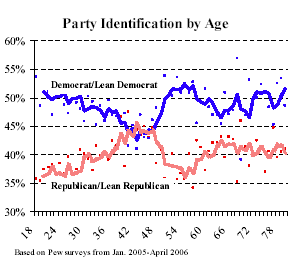
More than half of young people self identify as Democrats.

People in their 40s had the Reagan Revolution as their formative Republican experience. People in their 30s saw Newt Gingrich bring the GOP to power.

My generation has the disastrous presidency of George W. Bush as our only model of Republicanism. Endless war, lies, bigotry, hate, scandal, corruption, and bitter, divisive politics has not and will not endear the GOP to my generation. Like Americans in their 50s (who had the Nixon administration to form their first ideas about Republicans) my generation will probably carry our party identification with us for the rest of our lives. (See the chart above.)

I'm not saying that as my generation makes its way into office that it will usher in an age of Democratic dominance, but it will change the nature of the debate.

11.08.2006

Make Them Take it Away

Daily Kos has a DSCC press release:

Both Jon Tester and Jim Webb have won their races in Montana and Virginia but want to make sure that every vote is counted. We expect to have official results soon but can happily declare today that Democrats have taken the majority in the U.S. Senate.

Montana Vote Situation: Jon Tester leads Conrad Burns by approximately 1,700 votes (as of 11am EDT) and counting. In Silver Bow County (Butte), a Democratic stronghold, votes are still being counted but Tester is winning there with 66% of the vote. We expect to gain the majority of these uncounted votes and to add to Tester's margin.

Montana Process: When the counting phase is completed, a canvass will verify the vote tallies. That process could take as long as 48 hours, and must begin within three days and end within seven. Unless the canvass shows the margin to be within ¼ of 1%, there is no recount. As the loser, Burns would have to request the recount. When the votes are all counted, we expect to be outside that recount margin.

Virginia Vote Situation: Jim Webb is up by approximately 8,000 votes and once the provisional ballots are counted, we expect Webb's margin to increase. (Please note that VA absentees were included in the tallies from last night.)

Virginia Process: A canvass is underway to verify the results and we expect that process to finish within a day or so. To be in recount, the margin needs to be less than 1% and Allen (as the loser) would have to request it. Because of Virginia voting laws, the margin would have to be much tighter than it currently is to see any change in the outcome. Given the current margins, that is highly, highly unlikely.
Credit to the DSCC for handling this correctly. When the votes show that you're winning, declare victory and make the opposition try to take it away from the less powerful position of having fewer votes.

It would be better to put the candidates on TV and have them say something along the lines of "there are still votes coming in but I'm confident that the people of Virginia/Montana have chosen a new direction for America," but this will do.

In another time when Democrats were less confident (4 or 5 months ago) this sort of press release wouldn't have come out. Dems would have been concerned about 'looking dumb/over-confindent/elitist/liberal/pro-terrorist or whatever. Democrats were scared for so long that they became scared to do anything because it might backfire.

It's nice to see they've move (a little bit) past this.

It may take a month for their claims to be validated, but it's good that Tester and Webb have claimed victory.

11.01.2006

Democratic Defeatism

Mr. Greenwald at Unclaimed Territory has a wonderful post on the Baselessness of Defeatism among Democrats. An excerpt, though as with all his entries, you should read the whole thing:

...Americans didn't change their views because the media suddenly became adversarial or effective in its watchdog function (it didn't), nor because Democrats found a will or a way to provide meaningful opposition (they haven't), nor because the Bush administration's propaganda became any less ruthless or deceitful (it isn't). They changed their minds largely on their own, by simply looking at what is going on around them and using their critical faculties to compare what they see to the claims made by the Bush movement, and they have noticed the gaping disparities. And they are angry about it. Very angry.
The first time I was aware of what an election really meant for our country I had just started High School. Before then, elections were simply a time when the commercials on TV were terribly boring. When Clinton walked to re-election against Bob Dole in 1996, I was aware enough to form my own opinion about the candidates, (I liked Bill Clinton) though I was far more concerned with the worries and fears of a high school freshman than I was with politics.

Since then, I've watched my party, the Democrats, get beat routinely.

I didn't become a 'political person' until 2000 when I stayed up 'til 5 in the morning to find out if Gore beat Bush. When Gore threw in the towel in Florida, the tone for my entire political life was set: Republicans beat Democrats by being dishonest, cut-throat, better funded, and better at 'sound-bite' politics.

I've never seen Karl Rove lose.

Immediately after Kerry won the Democratic Nomination, he came to Harrisburg. I saw him speak to an excited crowd of 25,000 in a deep red part of my state. Months later, our hopes high to send W home after just one term (just like his father) Ohio replaced Florida and the losses continued.

I hope Mr. Greenwald will forgive me for not getting excited about the outcome of this election until the returns are in. I've been crushed to many times to raise my hopes. Democrats may be peaking at the right time, but I can't shake memories of Florida and Ohio.

Even charts like this feel like empty promises:

[Click to enlarge]

Republicans know that an opponent that expects to be beaten is already half way to defeat. Their talking heads have built a meme that purports that if Democrats don't win big, they are doomed to go the way of the Whig Party. If Democrats win control of the House by only one or two seats, the effort to paint them as losers, even in victory, will be strong.

On top of pre-existing Democratic insecurities, I watch the media attribute near mythic power to the Republican GOTV machine. Will this provide the cover needed for discrepancies between polls and Diebold machine vote tallies? We'll see.

Mr. Greenwald will have to forgive some of us 'Doubting Dems' for questioning the ability of the American Electorate to see the GOP for what it is. We've had 12 years of Rising Republicanism and voters have yet to repudiate it.

Hopefully now is the time.

10.31.2006

Democratic Victory = "America Loses"

From the lips of George W. Bush.

Once you understand this, the logic (yes, logic) is perfect.

Democrats winning in this election is only 'bad for America' because it's bad for Republicans and really bad for George W. Bush himself. But then again, for GOoPers, it's always about them. That's why the insurgency in Iraq is about the midterm elections.

I know it's Halloween and all, but I think that they're starting to sound scared...


10.24.2006

The Hard Truth

E.J. Dionne, whose columns I look forward to every week, has a new op-ed in today's Washington Post. As strong liberals, he has a message and a warning that we all need to hear:

President Bush's six-year effort to create an enduring Republican majority based on a right-leaning coalition is on the verge of collapse. The way he tried to create it could have the unintended consequence of opening the way for an alternative majority.

This incipient Democratic alliance, while tilting slightly leftward, would plant its foundations firmly in the middle of the road, because its success depends on overwhelming support from moderate voters. That's why a Democratic victory in November -- defined as taking one or both houses of Congress -- would have effects far beyond a single election year.

[...]

The strategy pursued by Bush and Karl Rove has frightened most of the political center into the arms of Democrats. Bush and Rove sought victory by building large turnouts among conservatives and cajoling just enough moderates the Republicans' way. But this approach created what may prove to be a fatal political disconnect: Adventurous policies designed to create enthusiasm on the right turned off a large number of less ideological voters.
As much as we hate to admit it, the majority of America resides somewhere between slightly left and slightly right on the political spectrum. When we have our majority (if we have our majority) we must be careful to bring moderates into our coalition. It might make progress slower but the current Conservative melt-down has taught us that governing with only the fringes may work for a while, but in the end you will alienate too large a portion of the electorate. 'Exciting the base' doesn't work forever.

I'm not suggesting that we abandon our ideals or water down our goals. We must remember to bring the middle with us, not ignore them as we govern. This is not a question of our policy or our ideology, it's a question of our attitude. The Republican Party's attitude towards moderates in the Bush Era was contempt. They drove them out of their party, demanded lock step agreement with the administration and punished dissent. If we treat moderates in the same way, we will find ourselves in the exact same position that the Republicans are now.

Well, we probably wouldn't start any unnecessary wars, so we'll call it a very similar position...

10.20.2006

Jesus Saves - Republicans Run Up the Debt

Republicans trot out the 'Democrats = higher taxes' argument every two years. A new poll in Virgina shows that the argument may not be as effective as it once was. From the Washington
Post
:

A large majority of Northern Virginia residents want the state to spend more money to fix the region's roads and rails, and more than three-quarters say they wanted the opportunity to raise local taxes to do it, a new Washington Post poll shows.
That's the thing about Republicans constantly bitching about already low taxes. Eventually, the government (local, state or national) can't live up to the population's expectations because it can't afford to provide the services that the people demand.

Taxes aren't money that the government steals from you. Taxes are a bill. The government uses that money for things like roads, military and police protection, a court system, and all the otherinfrastructure that makes life in the United States possible. The people of Norther Virginia (and I'm sure they're not the only ones) have figured that out. They've subconsciously done their cost/benefit analysis of higher taxes and better roads and decided that paying more for a better commute is worth it.

The GOP has handed the Democratic Party a wonderful opportunity. Their fiscal irresponsibility allow us to make this campaign speech:
A vote for Democratic candidate Smith is a vote for fiscal responsibility. Taxes are the bill for all of the good things that America gives to it's people. Roads, law enforcement, education, disaster assistance, clean water - things Americans have every right to expect from their government.

The Republicans have stopped paying the bills. On many things, it's even worse. My
Republican opponent, Sen. Johnson, voted with the rest of his party to borrow money to pay forXXXXX.

Sen. Johnson is going to try to scare you into voting for him by saying Democrats are going to raise taxes. Repealing tax breaks for the rich isn't raising taxes, it's going back to paying our bills. We have a lot of problems in this country and the government can't solve them for our people by running up the debt.
This does two things. It points out the devastatingly irresponsible way that the GOP has run our government and itinoculates voters against the tired 'tax and spend liberal' argument.

Nobody likes to pay taxes but a concerted effort to get people to understand what their getting from the taxes they pay would go a long way to making the Republican platform less appealing.

10.18.2006

A New Look for Congress

Harold Meyerson has a great (speculative) look at the first few weeks of a Democrat controlled congress in his Washington Post column:

In the House, the Democrats have made clear that there's a first tier of legislation they mean to bring to a vote almost immediately after the new Congress convenes. It includes raising the minimum wage, repealing the Medicare legislation that forbids the government from negotiating with drug companies for lower prices, replenishing student loan programs, funding stem cell research and implementing those recommendations of the Sept. 11 commission that have thus far languished.

All these measures command massive popular support. The reason they've not been enacted is that House Republicans have passed rules making it impossible for the Democrats to offer amendments to any significant legislation, thereby sparing themselves the indignity of having to choose, say, between the interests of their financial backers in the drug industry and their constituents.

Cognizant that they will owe their victory in part to the public's revulsion at the way Congress does (or avoids) business, the Democrats also plan to revise House rules to enable the opposition party to introduce amendments and to sit on conference committees, from which Republicans have routinely excluded them since Tom DeLay became majority leader. They also will ban members from accepting gifts and paid trips from lobbyists.
Not stuff that Rove & Co. will be able to use to scare up support from 'the base' - or at least not enough rabid-right-wing-revulsion to change the election. In fact, as Mr. Meyerson notes, these are all extremely popular pieces of legislation. Do Republicans chance filibustering the minimum wage increase? (If they did, would the Dems go nuclear?) Will Bush veto stem cell research again? As a lame duck, would he become a veto machine, trying to derail the Democratic agenda at every turn? Hard to say. Hopefully we'll see.

The big issue, though - and the one that can't be fixed in a few votes over the course of a week or so - is Iraq. Mr. Meyerson notes that if the Baker Commission recommends phased withdrawal, Dems will be lucky. If that recommendation is accepted by the Bush Administration, it would make a draw-down possible. Even if George W. Bush stays the course on Staying the Course, the Baker Commission would provide some political cover.

If none of this materializes, the Democrats would be left with a thorny and complicated problem. They can't just ignore the War in Iraq - it was the issue that brought them the majority - but politics won't let them unilaterally withdraw either. Meyerson believes that they'd be reduced to using the power of the purse to force the President's hand.

Hopefully it won't come to that. We'll know in a month.

10.12.2006

Warner Out, Edwards Up, Hillary Ahead

The Political Wire reports that Mark Warner, former Virginia governor, is NOT running for President in 2008:

When Mark Warner's political strategist, Mudcat Saunders, told Political Wire earlier this year that he thought John Edwards was the stronger candidate in 2008 it must have made Warner pause. With Warner now officially out of the running, the main beneficiary is John Edwards.

Edwards just lost his most serious Southern opponent and is now the clear favorite in South Carolina's primary. He has the best organization in Iowa and leads in the polls. He's actively against the Iraq war and admitted his Senate vote in favor of it was a mistake. He's also aggressively courted key Democratic constituencies with his efforts to end poverty. But most important, Edwards' "under the radar" strategy is building an impressive base of supporters around the country.
I haven't really looked at the 2008 races yet (best get past 2006 first) so I don't really know enough about Warner to say whether I'm happy or sad about him dropping out of the running. Edwards seems likable enough, though I'm not sure I'm ready to endorse him either.

All this said, whenever talking about the race for the 2008 Democratic Nomination for President, it all comes back to Hillary Clinton. I have issues with Hillary Clinton. She's pandered to the right a bit too much. We don't need a 'middle of the road' Democrat, we need a strong progressive. Her high negatives among many Americans are just another strike against her.

She does, however, have the money and the staff for a strong run. If there is a herd of Democratic hopefuls and she can win primaries with small pluralities, it's to her benefit.

We'll see how this shakes out later. I'm more concerned about this November than I am about November two years removed.

Bush: 'I'm not The Great Communicator' - World Shocked

Rawstory has this transcript from Bush's 10.11.2006 Press Conference:

QUESTION: One of the things Democrats complain about it is the way you portray their position –

BUSH : Oh, really?

QUESTION: – in wanting to fight the war on terror. They would say you portray it as either they support exactly what you want to do or they want to do nothing.

BUSH : Hmm.

QUESTION: We hear it in some of your speeches. Is it fair to portray it to the American people that way?

BUSH : Well, I think it's fair to use the words of people in Congress or their votes. [Laughs.] The vote was on the – on the Hamdan legislation, do you want to continue a program that enabled us to interrogate folks or not?

And all I was doing was reciting the votes. I – I – I would – I would cite my opponent in the 2004 campaign when he said there needs to be a date certain from which to withdraw from Iraq. I characterize that as cut-and-run because I believe it is cut and run. In other words, I've been using their votes or their words to characterize their positions.

QUESTION: But they don't say "cut and run."

BUSH : Well, they may not use "cut and run," but they say "date certain" as to when to get out before the job is done. That is cut and run. You know, I – nobody's accused me of having a real sophisticated vocabulary. I understand that. And maybe their – their words are more sophisticated than mine, but when you pull out before the job is done, that's cut and run as far as I'm concerned. And that's cut and run as far as most Americans are concerned.

And so yeah, I'm going to continue reminding them of their words and their votes.
So the President of the United States admits he's kind of a doofus at a press conference. Sad fact: This will get him more votes from the "plain ol' Uh-mer-ee-cun" subset of voters.

Is it wrong that I expect the President to be smarter than me, better read than me, more knowledgable than me and better spoken than me? Is that too much to ask?

10.10.2006

The Diebold Threshold?


This is the graphic that the USA Today is running at the top of a story that paints a pretty good picture for Democrats in November:

Democrats had a 23-point lead over Republicans in every group of people questioned — likely voters, registered voters and adults — on which party's House candidate would get their vote. That's double the lead Republicans had a month before they seized control of Congress in 1994 and the Democrats' largest advantage among registered voters since 1978.

Nearly three in 10 registered voters said their representative doesn't deserve re-election — the highest level since 1994. President Bush's approval rating was 37% in the new poll, down from 44% in a Sept. 15-17 poll. And for the first time since the question was asked in 2002, Democrats did better than Republicans on who would best handle terrorism, 46%-41%.

"It's hard to see how the climate is going to shift dramatically between now and Election Day," said John Pitney, a former GOP aide on Capitol Hill who now teaches at Claremont-McKenna College in California. He said Iraq remains the biggest problem for Republicans: "People just don't like inconclusive wars."
And by 'inconclusive' I'm assuming he means 'failed.'
Government corruption, Iraq and terrorism were the three most important issues. Along with their lead on terrorism, Democrats had a 21-point advantage on corruption and a 17-point advantage on Iraq. A 56%-40% majority said sending troops to Iraq was a mistake — the widest disapproval margin in a year.
All of this looks great. As I mentioned in the title, have we reached the point where even Diebold can't 'cover the spread?' It's easy to steal an election when polling indicates that the race is going to be very close but when the projected 5 or 8 point winner suddenly loses, questions come up.

If we haven't reached the point where the Republicans feel that they can't Diebold this election, have we reached the point where Democrats will stand and fight if they do?

I think we have.

10.06.2006

Foleygate: ALL DEMS FAULT!

I had CNN on last night while I was washing dishes. (Yeah, blogging pays REALLY well, but not well enough to add another domestic.) That asshat Michael Medved was on spouting bullshit about how the whole Foley situation was a Democratic conspiracy.

To hear Medved tell it, Democrats had known about Foley for a long time and waited until now, right before the election, to take it to the public.

While I stand in awe of Medved's ability to willfully remain ignorant of the facts of the story he's on national television talking about, what amazes me most is how stupid Michael Medved thinks Democrats are.

If we were 'sitting' on this story, why, for the love of God, would we dump in on the media at end of September rather than two weeks before the election?

Even though this is a 'sex with children' scandal, I don't think that Americans or the American media can stay focused on it for more than three weeks. That has the scandal dropping off of most voters radars right as the last push for votes is beginning.

That's just bad strategy - almost as bad as invading a large, ethnically diverse nation with all the makings of a civil war with no plans to secure the country after hostilities are over before finishing the last war we started...

* * * * *

Foleygate certainly isn't helping Republicans win votes in the upcoming election but I don't think that it will be swinging 50 seats towards the Dems, as a story Fox News is running to try to scare Conservatives into voting despite the scandal claims. All the arguments of 'who knew what when' are valid, but most people like their Representative. 'All the other idiots in Congress are shitbags except for my guy' is a popular thought regardless of party.

Most Republicans outside the leadership can make the same calls for investigation and demands that people be held responsible that Democrats can with just as much authority.

This scandal will probably keep down voter turn out among Republicans about as much as a good rainstorm that's only in GOPville. It will distract Republicans from their campaign plans and keep them off message for weeks. But the problem is that many districts are so gerrymandered that Republicans would get elected in certain districts even if they ate raw puppy meat live on TV.

Besides, when you have Diebold in your corner, why worry?

10.05.2006

The "Dems: Victory or Irrelevance" Meme

George Will's Washington Post column is largely fluff but the zinger at the end is the new Republican uber-meme:

Sinclair Lewis's "Elmer Gantry," like most of his novels, is dreadful as literature but splendid as a symptom. Published in 1927, the year Charles Lindbergh flew the Atlantic and Babe Ruth hit 60 home runs and the American craft of ballyhoo was being perfected, the novel was a cartoonish blast of contempt for tub-thumping evangelists who were doing well for themselves while pretending to do good works to redeem this naughty world. Gantry succumbed to temptations of the flesh and the real estate market. The modern twist to the fall of Foley -- public protector and private predator of children -- is the warp speed with which it moved from exposé to therapy: Foley, who has entered alcohol rehab, says he takes "responsibility" for what he has become as a result of abusive priests and demon rum.

[...]

Their story, of late, has been that theirs is the lonely burden of defending all that is wholesome. But the problem with claiming to have cornered the market on virtue is that people will get snippy when they spot vice in your ranks. This is one awkward aspect of what is supposed to have been the happy fusion between, but which involves unresolved tensions between, two flavors of conservatism -- Western and Southern.

The former is largely libertarian, holding that pruning big government will allow civil society -- and virtues nourished by it and by the responsibilities of freedom -- to flourish. The Southern, essentially religious, strand of conservatism is explained by Ryan Sager in his new book, "The Elephant in the Room: Evangelicals, Libertarians, and the Battle to Control the Republican Party":

"Whereas conservative Christian parents once thought it was inappropriate for public schools to teach their kids about sex, now they want the schools to preach abstinence to children. Whereas conservative Christians used to be unhappy with evolution being taught in public schools, now they want Intelligent Design taught instead (or at least in addition). Whereas conservative Christians used to want the federal government to leave them alone, now they demand that more and more federal funds be directed to local churches and religious groups through Bush's faith-based initiatives program."
Yes, yes. Good, good. We all already know that. Republicans allowing that maybe, just maybe there are cracks in the GOP monolith. This, of course, allows them to argue later that even if they are defeated electorially in the comming election (or elections) that it's only part of the party ideology that the public didn't like. It wasn't a rejection of Conservatism, just of one particular flavor.

A small, but somewhat important point that could forshadow the direction the GOoPers move should they find themselves out of power.

The important part of Will's column is the last paragraph:
After the 1936 election, in which President Franklin Roosevelt shellacked the Republican nominee in all but two states, a humorist wrote: "If the outcome of this election hasn't taught you Republicans not to meddle in politics, I don't know what will." If, after the Foley episode -- a maraschino cherry atop the Democrats' delectable sundae of Republican miseries -- the Democrats cannot gain 13 seats, they should go into another line of work.
This is the meme that the Republicans desperately want the media and the public and Democrats to internalize. If the Democrats do retake the House, the damage to Republicans is that they've lost the House. This is pretty straight forward and whether or not the "Dems must win or they will become irrelevant" meme has been accepted, the outcome is the same.

If the Democrats come up one or two seats short of control, this meme is tremendously destructive for Democrats. Instead of a huge recalibration of power and a rebuke of the direction that Republicanism has taken the country, the midterm elections - in which Democrats picked up seats - signals the 'Whig-ification' of the Democratic Party.

Now, I'm inclined to believe that if the Democrats don't take control of the house, its their own mistakes and ineptness that will cost them control but saying that Democrats should "find another line of work" if they don't (and by extension abandon governing to the Republicans) is stupid.

It took the Republicans years - decades - to build the system they have now. If in the years before 1994 conservatives had given up on their party (as many lefty bloggers threaten to do) do you think the GOP would be where it is today?

We need to learn from conservatives.

We need to build machinery for dissemination of our message. We need to build the party nationally, not just in 13 states. We need to grow candidates by supporting and encouraging Democrats to run in local elections.

That is going to take years. Just as failure to take the House won't doom the party to irrelevance, taking the House won't usher in an era of enlightened Democratic rule.

Failure to retake the house would be a disappointment for Democrats but we can't let the Republicans raise expectations (or lower them, depending on your point of view) to the point that they've defined victory such that they almost automatically win.

Don't fall into this trap. Don't spread this meme.

10.03.2006

Lieberman's Seniority - Updated

The Hill reports that Lieberman (I) has been promised that if he beats Lamont (D) he will retain his seniority:

"Lieberman said he assumed that would mean he would continue to serve as the top Democrat on the governmental affairs panel... That could create big problems with Democrats in Congress and around the country if their party takes over the Senate. The governmental affairs panel is primarily responsible for oversight and investigations of the executive branch."
This seems a bit strange to me. The Democratic Party has promised a candidate who lost his Democratic Primary and started his own party so that he could run for Senate gets to keep all the advantages of his years as a Democrat (good in quantity if not quality) even though he's no longer a Democrat?

So where's the repercussions for dropping out of the Party, ignoring the will of the voters in the primary, and the general anti-Democratic positions that Lieberman has taken? One would assume that by giving up his party membership he gives up the privileges as well.

I'm not demanding absolute party loyalty for politicians to receive chairmanships and other benefits. I just expect that Senior Democrat on any given Committee BE a Democrat. Is that so wrong?

UPDATE: More from The Hill article:
"Caucuses like to keep as many members as they can, not discourage membership," [said Lieberman] implying that leaders risk his defection to the GOP if they strip him of seniority.
So Entitlement Joe is blackmailing the Democratic Party into letting him keep his seniority?!?

Rage. Boiling. Over.

If Lamont doesn't win this thing, even if we pick up all the seats we need, Asshat Joe could switch parties and we still wouldn't get control of the Senate. And the people of Connecticut, who demonstrably don't want to elect a Republican, would have to wait six years to get rid of this guy?

The fact that Lieberman isn't a 'sure' member of the Democratic Caucus is reason enough for Dean and DNC to dump money into the Lamont Campaign. Lamont's ads have been good in the past. Hopefully his campaign will make something good out of this.

10.02.2006

Some Good News

Mason Dixon Polling results:

In WA, Maria Cantwell (D) leads Mike McGavick (R) 50%-40%.

In PA, Bob Casey (D) leads Rick Santorum (R) 49%-40%.

In MD, Ben Cardin (D) leads Michael Steele (R) 47%-41%.

In NJ, Bob Menendez (D) leads Tom Kean Jr (R) 44%-41%.

In OH, Sherrod Brown (D) leads Mike DeWine (R) 45%-43%.

In RI, Sheldon Whitehouse (D) leads Lincoln Chafee (R) 42%-41%.

In TN, Harold Ford (D) leads Bob Corker (R) 43%-42%.

In VA, George Allen (R) tied with Jim Webb (D) 43%-43%.

In MO, Jim Talent (R) is tied with Claire McCaskill (D) 43%-43%.
Take good news when you can get it...

9.29.2006

Better Late than Never?

E.J. Dionne, Jr. has a good, though many months late op-ed piece in the Washington Post today.

Bill Clinton's eruption on "Fox News Sunday" last weekend over questions about his administration's handling of terrorism was a long time coming and has political implications that go beyond this fall's elections.

By choosing to intervene in the terror debate in a way that no one could miss, Clinton forced an argument about the past that had up to now been largely a one-sided propaganda war waged by the right. The conservative movement understands the political value of controlling the interpretation of history. Now its control is finally being contested.
Of course Democrats waited nearly FIVE FUCKING YEARS to do this. In that HALF A DECADE a lot of opinions became firmly set. The narrative has already been set and largely accepted.

There are signs of life (and signs of spines) in the Democratic party for the first time since I became politically aware. I wonder, is it too little too late?

There are a lot of Progressives so disillusioned with the Democratic Party that they talk about finding 'other ways' to work towards Progressive and Liberal ideals. I think that's foolish. We are where the Republicans were 30 years ago. We need to slowly change the Democratic party in the same (structural) way that the Republicans have in the last quarter century. We need to build a support structure, an information distribution arm, and we need to ensure that Democrats running for office from state level Representatives to President are strong Progressives. We're working towards that. (I hope.)

But what will America look like by the time we catch up?

9.27.2006

Myth of the Moderate Republican

From Harold Meyerson's Op-Ed piece in today's Washington Post:

Sen. Lincoln Chafee, Republican of Rhode Island, is seeking reelection in his heavily Democratic state by insisting he's not really a Republican, or at least not part of the gang responsible for the decade's debacles. He didn't even vote for George W. Bush in 2004, he protests. He cast his vote for George H.W. Bush -- a kinder, gentler, more prudent, less strident Republican.

Big deal.

It matters not a damn whom Lincoln Chafee chose to support for president. His vote was one of roughly 435,000 cast in Rhode Island in the 2004 presidential election, and roughly 122 million cast nationwide. The election in which his vote did matter was that for majority leader of the Senate. There, he was one of just 100 electors, in a Senate nearly evenly divided. After this November's elections, control of the Senate may well hang by a single vote.
Mr. Meyerson is exactly right. The vote for Majority Leader is the most important vote any Senator will make because it will determine every other vote the Senator will make while in office. A two party system and a non-parliamentary system have left us in a situation where our democracy, particularly in the House and Senate, is set up so that 50% +1 has political power far greater than numbers justify. Having the majority (and with it committee chairs) allows a party to control the conversation. It allows the majority party to set the schedule, the agenda, and the pace. It allows the majority to protect members from votes that would be unpopular at home. (Read: Democrats in Red States)

Mr. Meyerson's point, that voting for any candidate that would hand over this power to the extremist wing of the Republican Party is foolish if you are looking for a candidate to moderate the course in Washington, is one to which many voters should pay attention. It illuminates the fact that national politics isn't about picking the candidate that you 'like' better but about picking the candidate that you think will have the impact you want in Washington.

The idea also works in reverse.

Though I haven't heard much of it lately, the Liberal Blogosphere has always rumbled about voting out Dems that cross party lines to vote with Republicans. There are calls to stop supporting candidate X because he/she voted this way on a certain bill. "Vote a third party to get 'turncoat X' out of congress!"

This is, of course, foolish.

While candidate X may vote for an odious bill once in a while, he/she will certainly NOT vote for a Republican for Majority Leader. Withdrawing our support from Democrat X may well result in Republican Y getting elected. You've now gone from a congressperson that voted with Republicans 5% of the time to one that votes with Republicans 100% of the time. Where's the victory in that?

I understand the arguments about presenting a party of strong ideals, principals that won't be compromised, and candidates willing to take a stand for what they believe in. This is important. But if expecting absolute, lock-step, party-line voting is going to cost Dems a seat, is it worth it?

Like all things, this is a nuanced subject. There can be no set rule about how much compromise is too much compromise. No number of votes or number of speeches demonizing Dems and lionizing Republicans signifies the tipping point of a Dem becoming a detriment to the party. (cough, cough, Joe Lieberman, cough) When those Democrats can be replaced in a primary with a Democrat with a good chance of winning the election, we should not hesitate to jump on the opportunity.

All I'm saying is that getting Democrats in Congressional Seats is the most important thing we can be doing right now.

9.26.2006

PA Politics - Blue and Getting Bluer UPDATED

A new Quinnipiac poll is out for Pennsylvania and the results show that Pennsylvanians haven't lost their minds:

Democratic State Treasurer Robert Casey Jr. has regained his momentum in the Pennsylvania U.S. Senate race and now leads incumbent Republican U.S. Sen. RickSantorum 51 - 39 percent among likely voters, with 4 percent for Green party candidate Carl Romanelli and 5 percent undecided, according to a Quinnipiac University poll released today.

Republicans back Sen. Santorum 77 - 17 percent, while Democrats back Casey 85 - 8 percent and independent voters back the Democrat 56 - 31 percent. In this survey,
17 percent of likely voters who name a candidate say they still might change their mind.

[...]

"Sen. Rick Santorum's comeback momentum has been stopped dead in the water. Santorum's attack ads against Casey have failed to spark voters' support, and 50 percent of voters say the Senator does not deserve re-election," said Clay F. Richards, assistant director of the Quinnipiac University Polling Institute.
Quinnipiac's last poll had Santorum trailing by only 6 points, 48% to 42%.

All the trends are against Santorum. Bush is strongly disliked in Pennsylvania, his approval rating is only 38%. Pennsylvanians don't like Santorum personaly either. The Senator's approval rating is even lower at 35%. In addition, Rick Santorum's family lives in Virginia.

In general, things look good for Democrats in Pennsylvania

According to a Rasmussen Reports survey the Republican candidate for Governor of Pennsylvania, Lynn Swann, is trailing significantly. Ed Rendell, the incumbent, leads Swann 56% to 36%. Swann actually polled ahead of Rendell in the begining of the year.

In south eastern PA, in the suburbs of Philly, a Temple University/Philadelphia Inquirer poll has shown that strong disapproval of President Bush is affecting House races in the area:
"The Bush effect -- strongest in the southeast region -- is acting as a drag on Republican U.S. Sen. Rick Santorum, and tugs at GOP House incumbents in suburban Philadelphia, who are locked in three of the nation's most competitive races."

[...]

The Temple/Inquirer Poll asked respondents to rate their feelings toward candidates for Senate and governor on a scale of zero to 10.

Twenty-four percent of likely voters gave Santorum a zero, far more than any other candidate. Democrats were the most hostile, but 51 percent of independents rated Santorum below 5 - and 26 percent of these voters gave him a zero.

[...]

People who said they disapproved of Bush's performance were much more likely to indicate they would vote Democratic in House races, the poll found, a sign that GOP House members are tied in part to the president. Fifty-eight percent said they disapproved of the way Bush is doing his job, while 42 percent said they approved.

Republicans hold the three House seats outside Philadelphia - the Sixth, Seventh and Eighth Districts - and the Democratic candidates are considered competitive in each race. Together, the two major parties have reserved $16.1 million worth of TV advertising time in the Philadelphia market for House candidates in the last month of the campaign.
I miss all of the good campaign ads I used to see in Pennsylvania. Here in Maryland, they just assume you'll vote Democratic so they don't bother to buy air time. Sometimes we get ads from Virginia races. The Republican ads there are utterly contemptible and I don't even get satisfaction of voting against them...

UPDATE: 10:22 am

The Washington Post reports that the Green Party, which gathered signitures with Republican money and Republican staffers, will not be on the ballot:
HARRISBURG, Pa., Sept. 25 -- A judge said Monday that he will remove the Green Party candidate for U.S. Senate from the November ballot because the party did not have enough valid signatures in its nominating petitions.

Carl Romanelli's candidacy for the Pennsylvania seat had been challenged by state Democrats. Romanelli's bid was backed by Sen. Rick Santorum (R), who hoped that Romanelli could siphon votes from his Democratic opponent, state Treasurer Robert P. Casey Jr.

[...]

Commonwealth Court Judge James R. Kelley ruled that Romanelli, a railroad industry consultant from Wilkes-Barre, was 8,931 signatures shy of the 67,070 he needed to qualify as a minor-party candidate.
In general, I'm in favor of having as many parties and as many candidates running as possible. More views, more positions and more options is always good for voters. It allows them to have more than two colors to express themselves.

This, however, wasn't what was going on here. This was an effort by one candidate to 'double up' on the ballot.